The Only Minnesota-First, 2022-Standards-Aligned High School Math Curriculum
MEG Intermediate Algebra, Algebra 2, and Geometry were built from the ground up for Minnesota classrooms, from the 2022 Minnesota Academic Standards, not retrofitted from a national curriculum. Every decision, from the problems we write to the way we structure class time, was made with Minnesota students and teachers in mind. Here are the twelve things that make us different.
"The only Minnesota-first, 2022-standards-aligned high school math curriculum."
That's not a slogan. It's the product description. Every MEG course starts with the 2022 Minnesota Academic Standards and builds forward. No national curriculum adapted to look local. No retrofitting after the fact.
Built by Merit Education Group, a Minnesota-built solution from day one
153+ core lessons per course (9 units × 17 lessons) + 15 flex days
Every lesson, assessment, and practice set written directly to MN standards

Built from the 2022 Minnesota Academic Standards from Day One
Not retrofitted from a national curriculum. MEG was designed backward from the 2022 Minnesota Academic Standards, using the three-strand model: Data & Probability, Spatial Reasoning, and Patterns & Relationships. The result is a curriculum that is MCA-IV ready for the 2027–28 assessment transition.
Three-strand model: Data & Probability, Spatial Reasoning, Patterns & Relationships
MCA-IV ready for the 2027–28 assessment transition
Every assessment item tagged with its exact 2022 benchmark code
Standards Are the Starting Point
Most publishers write a curriculum, then map standards onto it. MEG starts with the standards and builds every lesson from them, so alignment is structural, not claimed.
Source-Verified Minnesota Career Bank
Every lesson is career-connected to a real, source-verified MN career, with wage data verified against the Minnesota Department of Employment & Economic Development (DEED) OES data and O*NET. 28 verified careers spanning medical → legal → parks & recreation → hospitality → forestry → industry.
28 verified Minnesota careers across six industry bands
Wages verified against MN DEED OES data and O*NET
Real MN salaries: Judge $175,864 · Lawyer $110,219 · Wildlife Biologist $57,221 · Park Naturalist $53,061 · Recreation Worker $34,050 · Lifeguard $29,723
25th-percentile wage × 2080 hours: entry-level, credential-aligned
Never generic career mentions, always verifiable MN careers

Where Careers Meet Algebra: Medical Lab Scientist at Mayo Clinic, $63,150/yr (MN DEED OES 2026 Q1, 25th percentile × 2080 hrs).
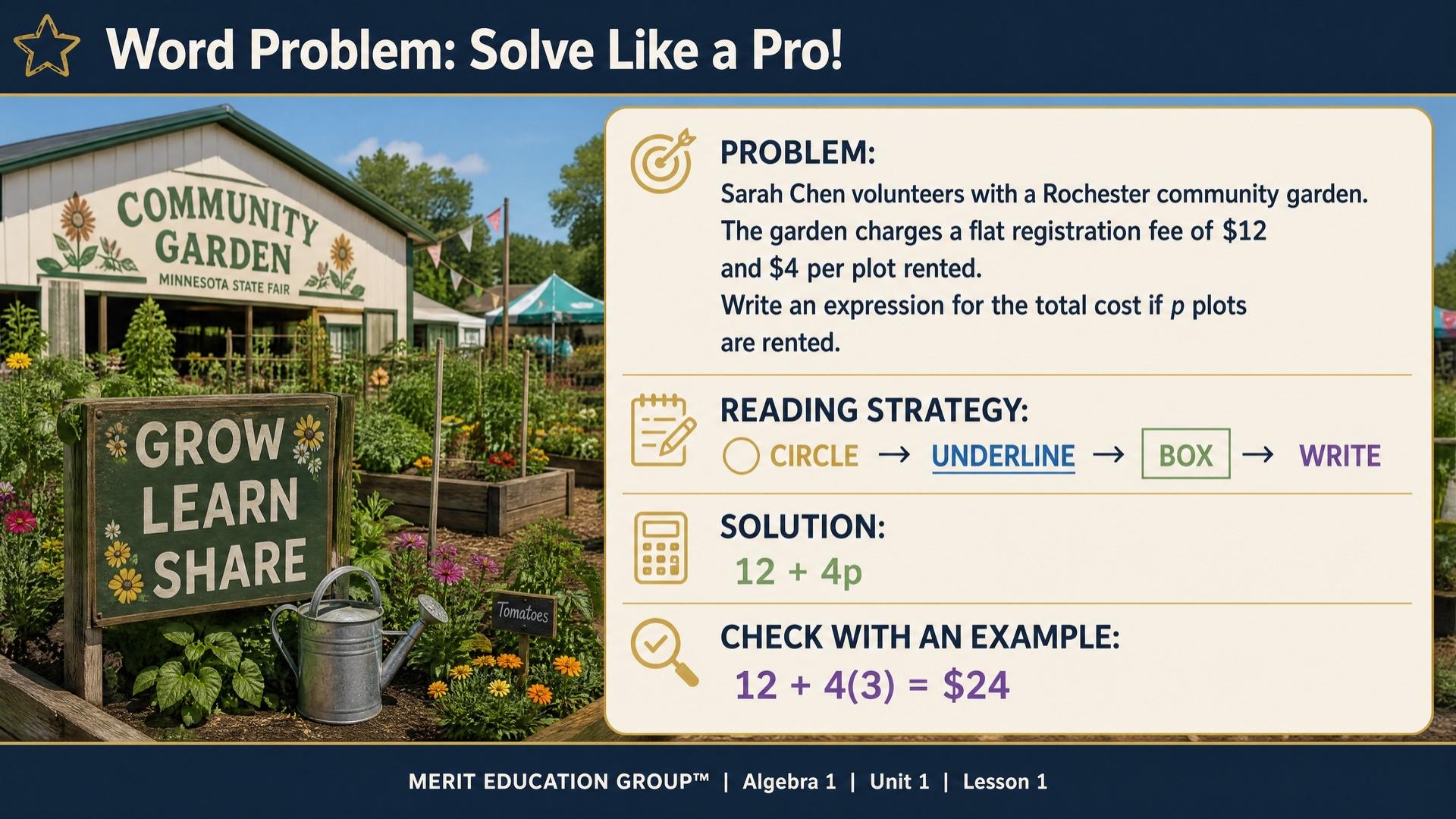
The lab problem: students model tasks with s × h + 5. Variables appear in every career.
258-Theme Minnesota Slide-Deck Design Bank
Every lesson deck is themed to a real Minnesota attribute, one of 258 themes across 11 categories: amphitheaters & music, lakes, Boundary Waters & northwoods, cars & transportation, farming, parks & recreation, landmarks & cities, culture & history, winter & seasonal, industry & innovation, and hospitality.No two lessons share a theme.
258 real Minnesota themes, never generic clip art
11 categories: music, lakes, Boundary Waters, cars, farming, parks, landmarks, culture, winter, industry, hospitality
Every lesson deck visually distinct. No two lessons share a theme
The Theme Categories
Merit Time Signature Game Rotation
A brand-new, zero-device PBIS-integrated classroom game debuts at the start of every unit:12 games across the course. No scoreboards, no timers, no devices, friendly competition with natural rewards.
Expression Speed Sort
Equation Relay Race
Function Machine
Line-Up
System Smackdown
Exponent Escape Room
Polynomial Pictionary
Factoring Frenzy
Quadratic Quiz Bowl
Data Detective
Probability Carnival
Unit 1's Translation Match
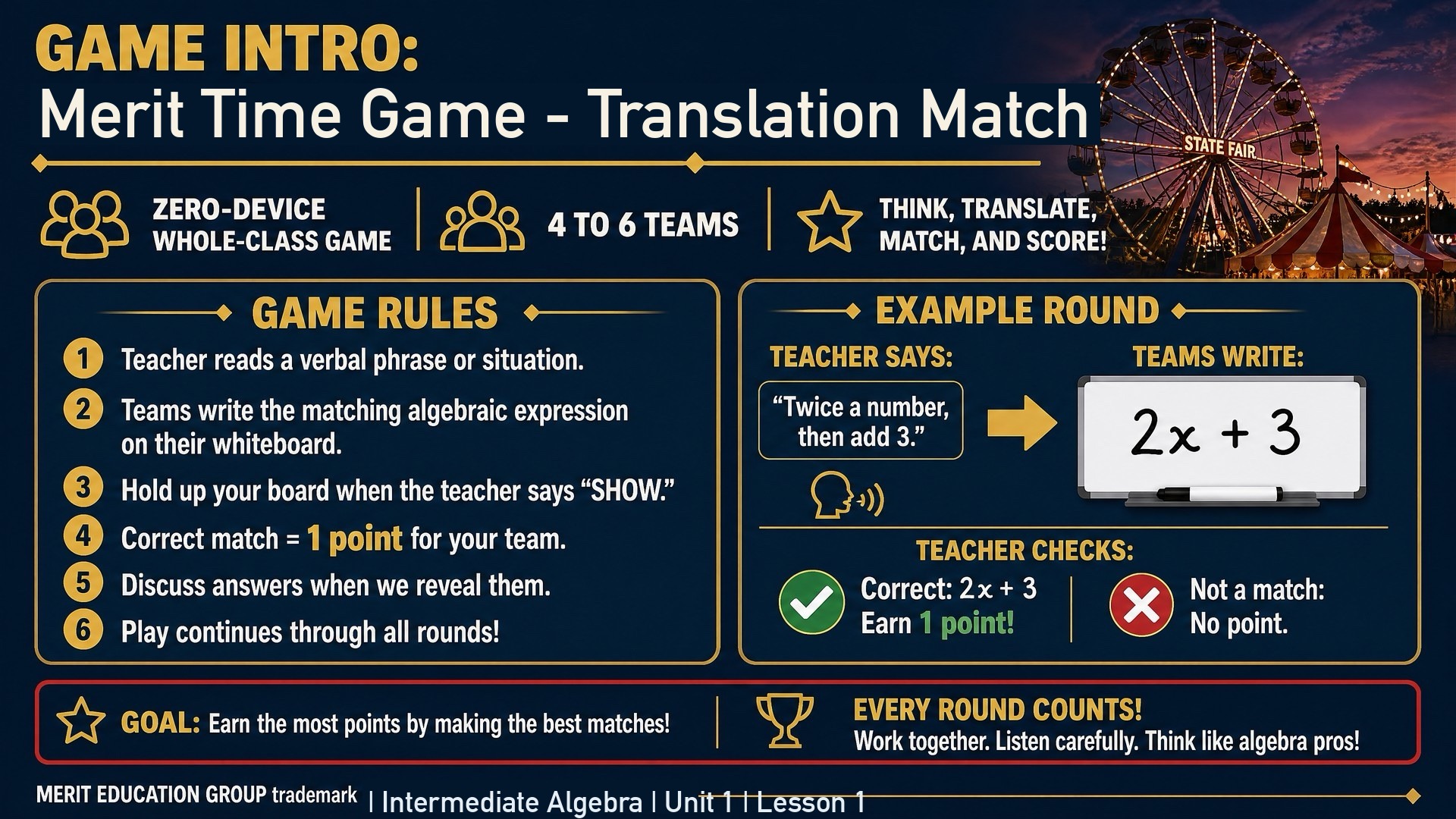
Zero-device, fast-paced, whole-class. PBIS bonus points built into every round.
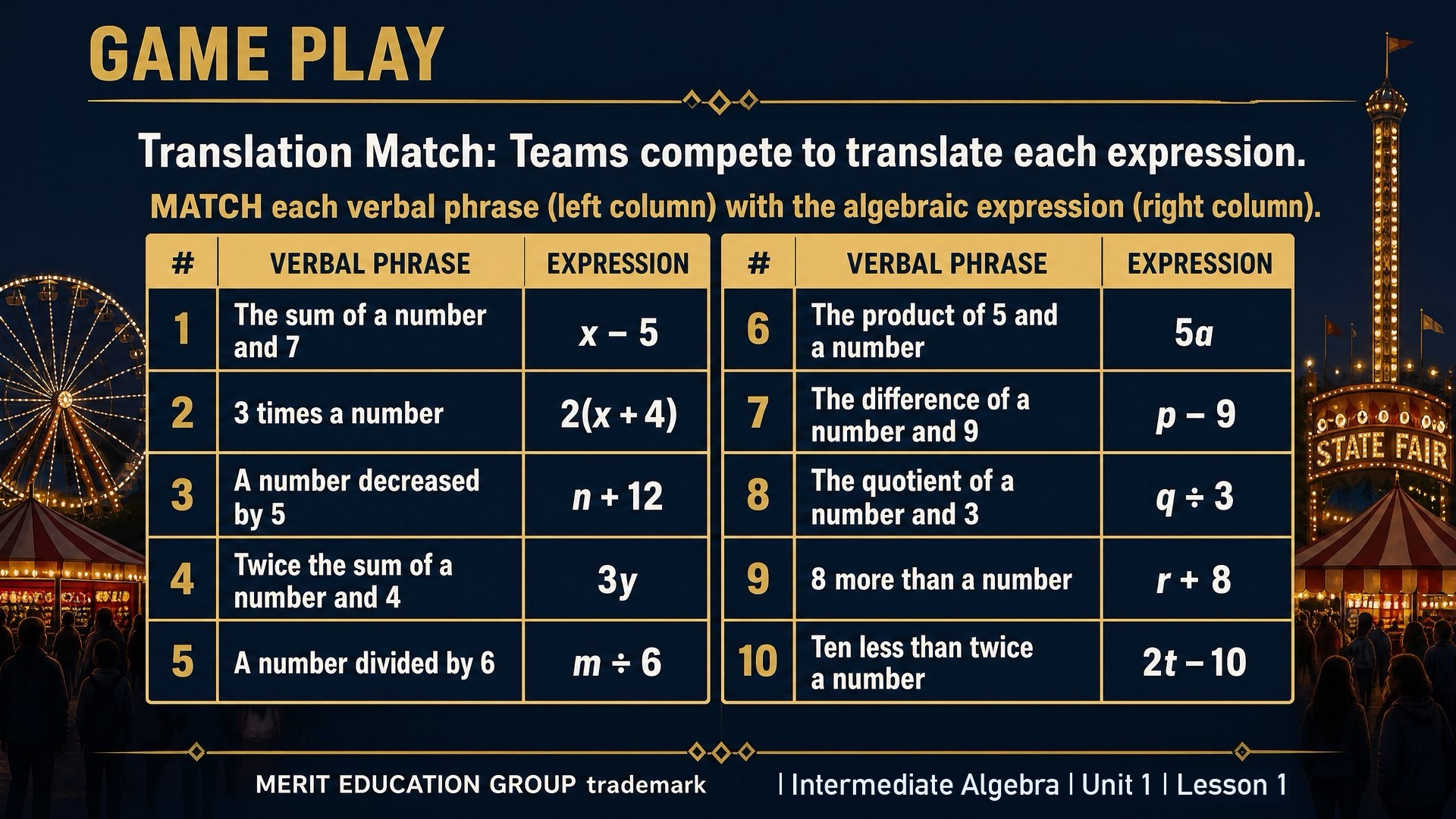
Teams compete to solve. Natural reward moments, no treasure chest needed.
PBIS Built Into Lesson DNA
Merit Time is the classroom-wide PBIS system, Be Ready, Be Respectful, Be Responsible, not a game add-on. Teacher scripts live in every lesson, and the signature games ship with complete PBIS game masters.
Three core expectations woven into every lesson: Be Ready, Be Respectful, Be Responsible
Teacher scripts in every lesson; PBIS game masters for the signature games
Classroom PBIS poster and teacher implementation guide
Natural reward moments, no stickers or treasure chest needed
One System, Every Lesson
Be Ready
Warm-up routines, transition signals, material checks built into the slide deck.
Be Respectful
Think-Pair-Share protocols, discussion norms, Merit Time game conduct.
Be Responsible
Guided notes accountability, self-check moments, exit ticket routines.
MTSS Embedded, Not Bolted On
Three adaptive pathways per unit, Enrichment 85%+, Targeted 65–84%, Rebuild <65%, with Core/Support/Extension versions of every lesson, 15 flex days per course, and diagnostic pretests at course and unit start.
Three adaptive pathways per unit: Enrichment 85%+, Targeted 65–84%, Rebuild <65%
Core/Support/Extension versions of every lesson
15 flex days per course for reteaching and enrichment
Diagnostic pretests at course start and unit start
Enrichment
85%+
Extension problems, deeper applications, accelerated pacing
Targeted
65–84%
Core instruction with embedded supports and strategic scaffolding
Rebuild
<65%
Rebuild pathways with targeted intervention and flexible pacing
ELL/MLL Supports in Every Lesson
Bilingual vocabulary cards, sentence frames, visual aids, cognate awareness, language objectives, and assessment accommodations: in every lesson, not a separate packet.
Bilingual vocabulary cards and cognate charts
Sentence frames embedded in every lesson
Visual aids and language objectives for every lesson
Assessment accommodations, not a separate ELL packet
Spanish guided notes and worksheets available
From the Actual Guided Notes: L01
Definition: A variable is a __________ that represents an unknown __________.
(Answer: symbol, value)
Fill-in-the-blank format with strategic blanks at key concepts, plus Spanish-first transitional versions for ELL students.
Tribal Nation Contexts per MN Statute 120B.021
Ojibwe and Dakota contexts, star quilts, tipi geometry, tribal budgeting, with facts verified against primary sources. Culturally responsive names throughout: Hmong, Somali, Ojibwe, Dakota, Latino.
Ojibwe and Dakota contexts: star quilts, tipi geometry, tribal budgeting
Facts verified against primary sources
Culturally responsive names: Hmong, Somali, Ojibwe, Dakota, Latino
Aligned with MN Statute 120B.021 American Indian education requirements
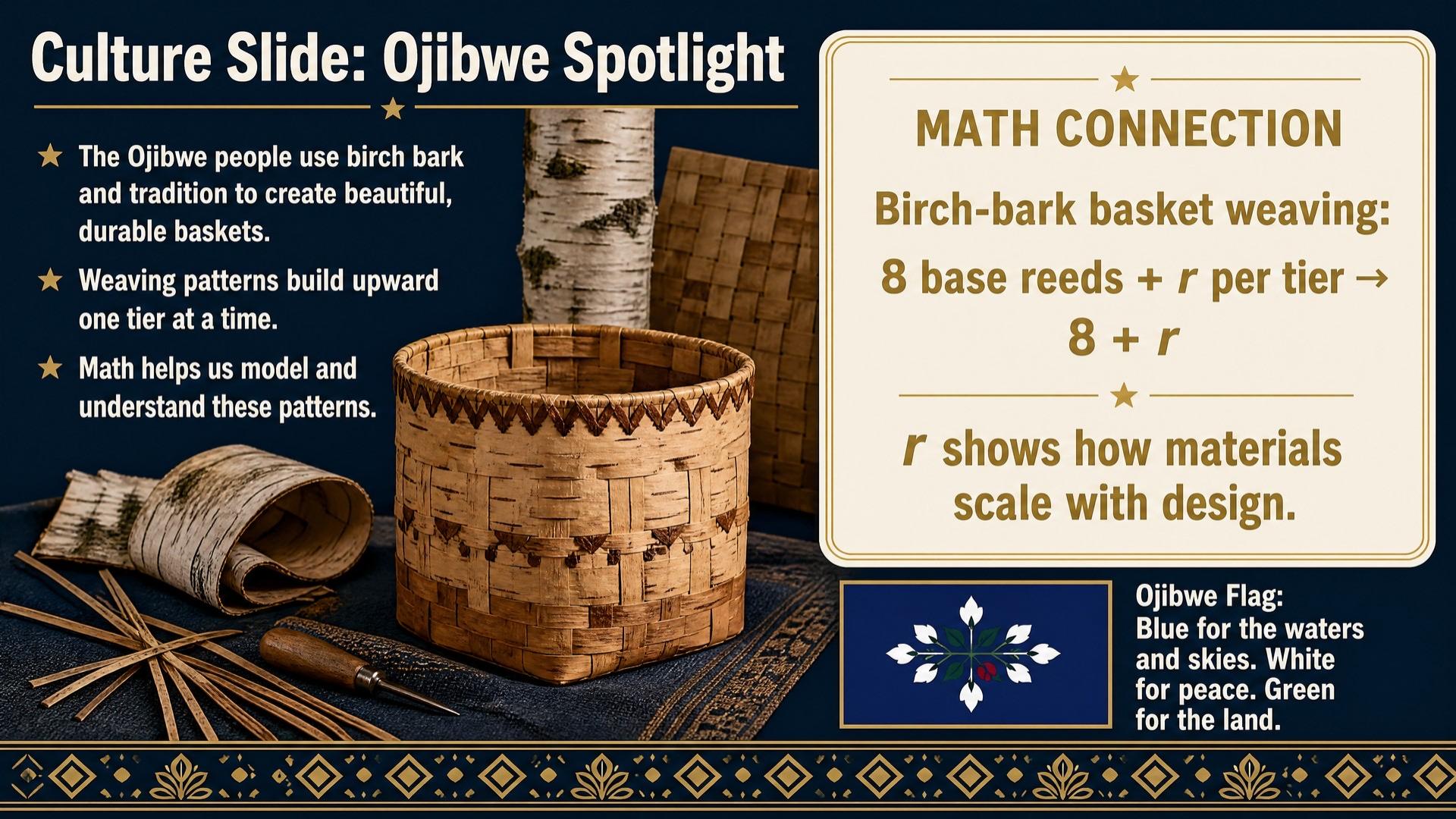
Ojibwe wild rice harvest near Mille Lacs, heritage spotlight paired with the math.
Dual-Platform Ready
Identical curriculum in Google AND Microsoft formats, open, edit, and assign in the workflow your district already uses, with no platform lock-in.
All slide decks in Google Slides AND PowerPoint
All documents in Google Docs AND Word format
Works with Schoology, Canvas, Google Classroom, any standards-compliant LMS
No platform lock-in. Switch formats anytime
One Curriculum, Two Platforms, Any LMS
Slides + Docs
Microsoft
PowerPoint + Word
Same curriculum, both platforms
Every resource ships in the format your district already uses
Standards-Tagged Assessments
Every unit ships Quiz 1, Quiz 2, and an End-of-Unit Test. Every item is tagged with its exact 2022 benchmark code, Standards for Mathematical Practice, and context tag. Teachers see exactly which standard each student has mastered. No manual tagging.
Every assessment item tagged with its exact 2022 benchmark code
Standards for Mathematical Practice and context tag on every item
Teachers see exactly which standard each student has mastered
No manual tagging: data is PLC-ready from the first assessment
Student versions included for every assessment, easy printing
Assessment Suite: Unit 1
Completeness: Everything Teachers Need Per Unit
A 12-category folder structure per unit, vs. competitors' 2–5 files per unit. The complete Unit 1 sample kit ships 244 files.
Scope & sequence
Pacing
Slide decks
Lesson plans
Teacher editions
Tiered worksheets (English + Spanish)
Assessments with student versions
Guided notes (print + fillable)
Bell ringers
Family letters (English, Hmong, Somali, Spanish)
Teacher resources
Substitute plans
Full-unit visual vocabulary posters
The Unit 1 Sample Kit
This Is What Different Looks Like
Not convinced yet? See the difference for yourself: preview an entire lesson with all the materials, differentiation, and quality we've described.
View a Sample Lesson