What Is a Variable?
A complete walkthrough of a MEG Intermediate Algebra lesson, representative of our approach across Intermediate Algebra, Algebra 2, and Geometry. Built to Minnesota Academic Standards with embedded ELL supports, SPED accommodations, career connections, and word-problem fluency development in every lesson.All sample materials below are from our actual curriculum. Download and see for yourself.
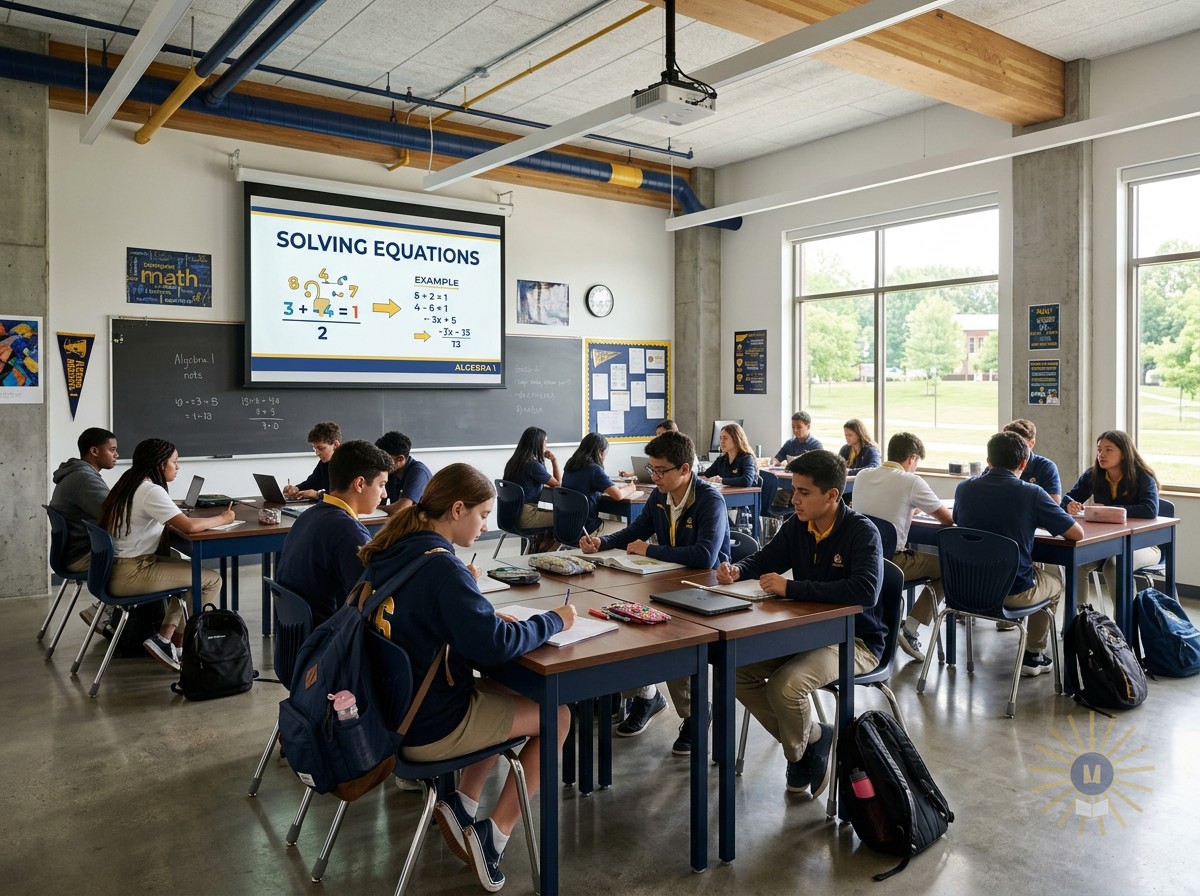
The Four-Phase Lesson Structure
Every MEG lesson follows the same consistent structure: predictable pacing, embedded differentiation, and career connections in every phase.Every lesson also adapts cleanly to a 90-minute block.
Phase 1
3–4 minBell Ringer
Arithmetic fluency and pattern recognition in a whiteboard-based, low-stakes warm-up that reactivates prior learning
Predictable start reinforces the PBIS expectation "Be Ready": materials out, focus on the board
Phase 2
4–5 minLaunch / Hook
Essential question + career spotlight: Anishinaabe basket weaving, Medical Lab Scientist salary modeling, and more
Frames the day's learning in a question students can answer by the end of class
Phase 3
20–24 minExplore & Develop
Direct instruction with teacher modeling, precision language, and embedded checks, then collaborative problem-solving
Tiered independent worksheet (T1/T2/T3), where every student works at the right level while the teacher circulates
Phase 4
8–10 minReflect & Practice
Zero-device, PBIS-integrated. Translation Match is skill practice as friendly competition
2-minute formative assessment directly tied to the lesson objective
Clear preview connecting today's learning to what comes next
Lesson 01: What Is a Variable?
This is the real lesson plan, pulled directly from our Unit 1: Variables and Expressions. Every word below is from the actual curriculum.
 Merit Education Group
Lesson
U1L01: What Is a Variable?
Duration
50 minutes (adaptable to 90-minute block)
MN Standards
MN 9.3.5.3, MN 9.3.5.7, MN 9.3.5.8
Career Connection
Medical Lab Scientist, Mayo Clinic
Objective
Define a variable and distinguish it from constants and coefficients. Identify variables in algebraic expressions and write one-variable expressions to model quantitative situations.
Key Vocabulary
Enduring Understanding
Variables are symbols that represent unknown or changing quantities. They let us generalize relationships instead of computing single answers.
Direct Instruction (I Do): 6 min
Teacher Script:
Variable: A letter or symbol that represents an unknown quantity or a value that changes within a given context. Variables allow us to generalize relationships rather than compute single numerical answers.
Expression: A mathematical phrase composed of numbers, variables, and operation symbols. Expressions do not contain equality or inequality signs.
Constant: A fixed numerical value in an expression that does not change.
Coefficient: The multiplicative factor placed directly before a variable term. If no number is written, the coefficient is implicitly 1.
Precision Language
"We do not say 'x times n.' We state: 'the product of a constant and a variable' or use proper notation."
Culture & Career Spotlight: 6 min
Anishinaabe Basket Weaving
Traditional weavers use 8 + r to model total reeds, where r captures how material needs scale with design complexity.
Career: Medical Lab Scientist, $63,150/yr
A medical lab scientist at Mayo Clinic, Rochester MN. The salary comes from MN DEED OES 2026 Q1 data (25th percentile × 2080 hrs), verified against O*NET. s × h + 5 models total tasks as samples per hour, hours worked, and quality checks. Variables enable career modeling rather than static calculations.
Guided Practice (We Do): 8 min
Example 1: Identification
7k - 4
Identify the variable, constant, and coefficient.
Variable: k | Constant: -4 | Coefficient: 7
Example 2: Translation
Write an expression for "5 less than three times a number."
Solution: Let n represent the unknown number. 3n - 5
Example 3: Real-World Model
A community garden charges a flat fee of $12 and $4 per plot rented. Write an expression for total cost if p plots are rented.
Solution: 12 + 4p
Independent Worksheet: 18 min (9 work + 9 circulate)
Identify variables/constants/coefficients in given expressions; match verbal phrases to one-variable expressions.
Write one-variable expressions from multi-step verbal descriptions and real-world scenarios.
Determine if two expressions are equivalent when variables are assigned specific values; justify using substitution.
Common Misconceptions & Redirect Strategies
| Misconception | Redirect Question |
|---|---|
| Confuses variable with constant | "Which part changes depending on the situation?" |
| Writes 5 × n instead of 5n | "How do mathematicians abbreviate multiplication?" |
| Translates "3 less than x" as 3 − x | "Read carefully: what is being decreased?" |
Exit Ticket: 2 min
1. Define a variable in your own words using precise mathematical language.
2. Write an algebraic expression for: "Twice a number decreased by 9." Let n represent the unknown number.
Formative assessment directly tied to the lesson objective. Word-problem readiness check.
Materials Checklist
- Whiteboards, markers, erasers (1 set per student)
- Direct Instruction slide deck (Navy #1C2950 headings, Arial body)
- Guided Practice handout (3 examples + GEMDAS reminder)
- Tiered Independent Worksheet (T1/T2/T3 versions)
- Merit Time: Translation Match card sets (laminated, zero-device)
- Exit Ticket slips
- Visual vocabulary anchor chart
Differentiation Built Into This Lesson
These supports are not optional add-ons. They are designed into the lesson structure itself. Every MEG lesson includes accommodations for ELL, SPED, support, and extension.
Pre-teach vocabulary with bilingual glossaries and visual anchors.
Provide sentence frames for exit ticket: "A variable is a ______ that represents ______." Pair ELL students with structured peer supports during the Translation Match game.
Guided Notes (L01) with embedded English Learner supports: sentence frames, cognate charts, and a visual glossary woven into every lesson.
- Provide graphic organizers with labeled slots for Variable, Coefficient, Constant
- Allow use of concrete manipulatives (algebra tiles, colored counters)
- Extend independent work time using the built-in 9-minute circulate window
Unit 1: Variables and Expressions
Seventeen lessons building from defining variables through career-connected review. Every lesson reinforces word-problem interpretation and algebraic modeling.
17
Lessons
20
Instructional Days
50
Assessment Files
5
MN Standards
| Lesson | Title |
|---|---|
| 1 | What Is a Variable? |
| 2 | Translating Verbal Phrases |
| 3 | GEMDAS Basics |
| 4 | GEMDAS: Advanced |
| 5 | Evaluating: One Variable |
| 6 | Evaluating: Multiple Variables |
| 7 | Real-World Formulas |
| 8 | Identifying Terms, Coefficients & Constants |
| 9 | Combining Like Terms |
| 10 | The Distributive Property |
| 11 | Distributive + Combining Like Terms |
| 12 | Equivalent Expressions |
| 13 | Writing Equivalent Expressions (GCF) |
| 14 | Perimeter, Area & Algebraic Expressions |
| 15 | Translating Real-World Scenarios |
| 16 | Personal Finance: Budgeting |
| 17 | End-of-Unit Test |
The Actual Lesson Slide Deck
These are real slides from the L01 lesson deck, the same deck teachers project in class. Bell ringer, culture spotlight, career spotlight, merit time game. Every phase is built in.
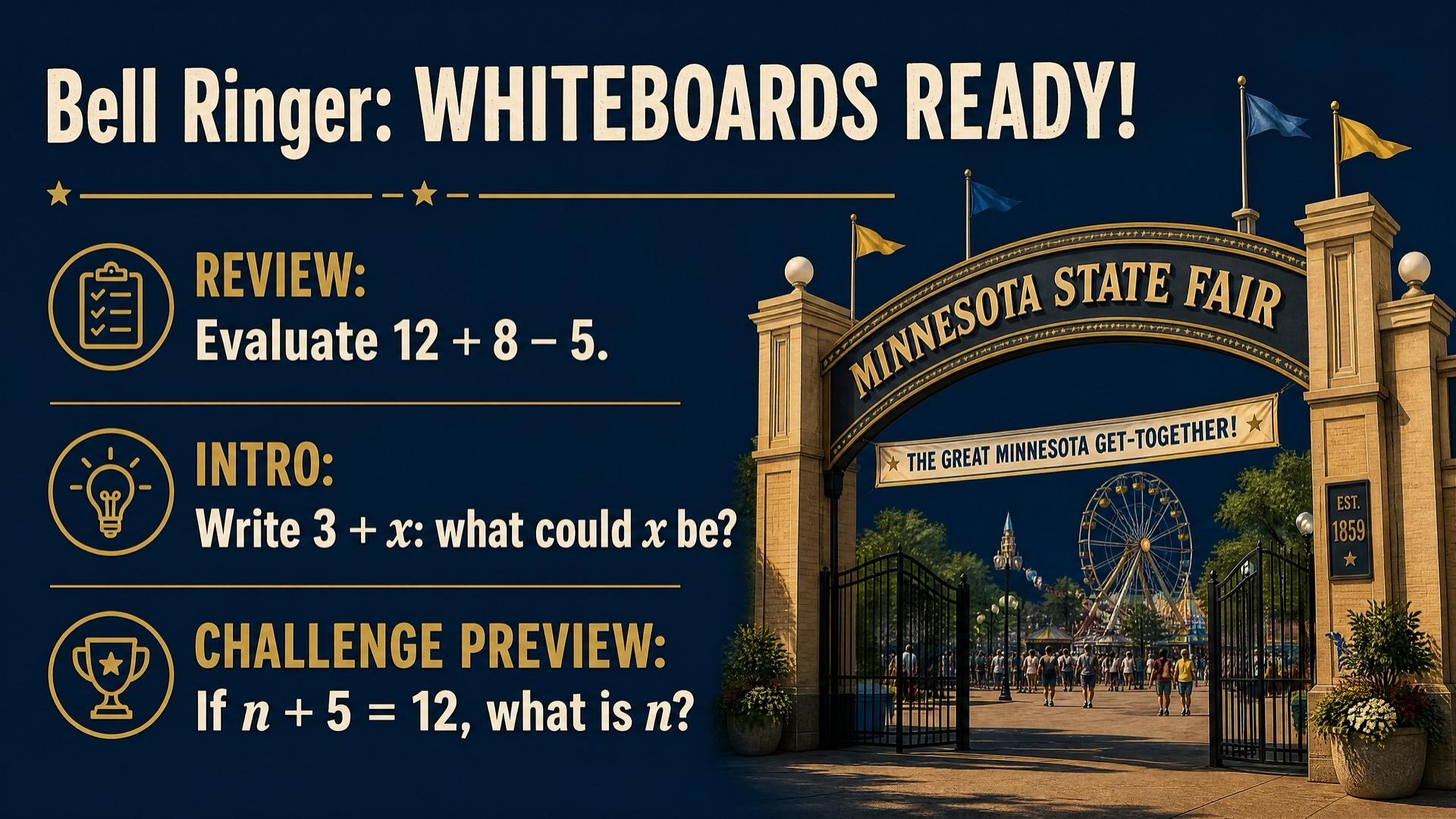
Bell Ringer: whiteboard warm-up
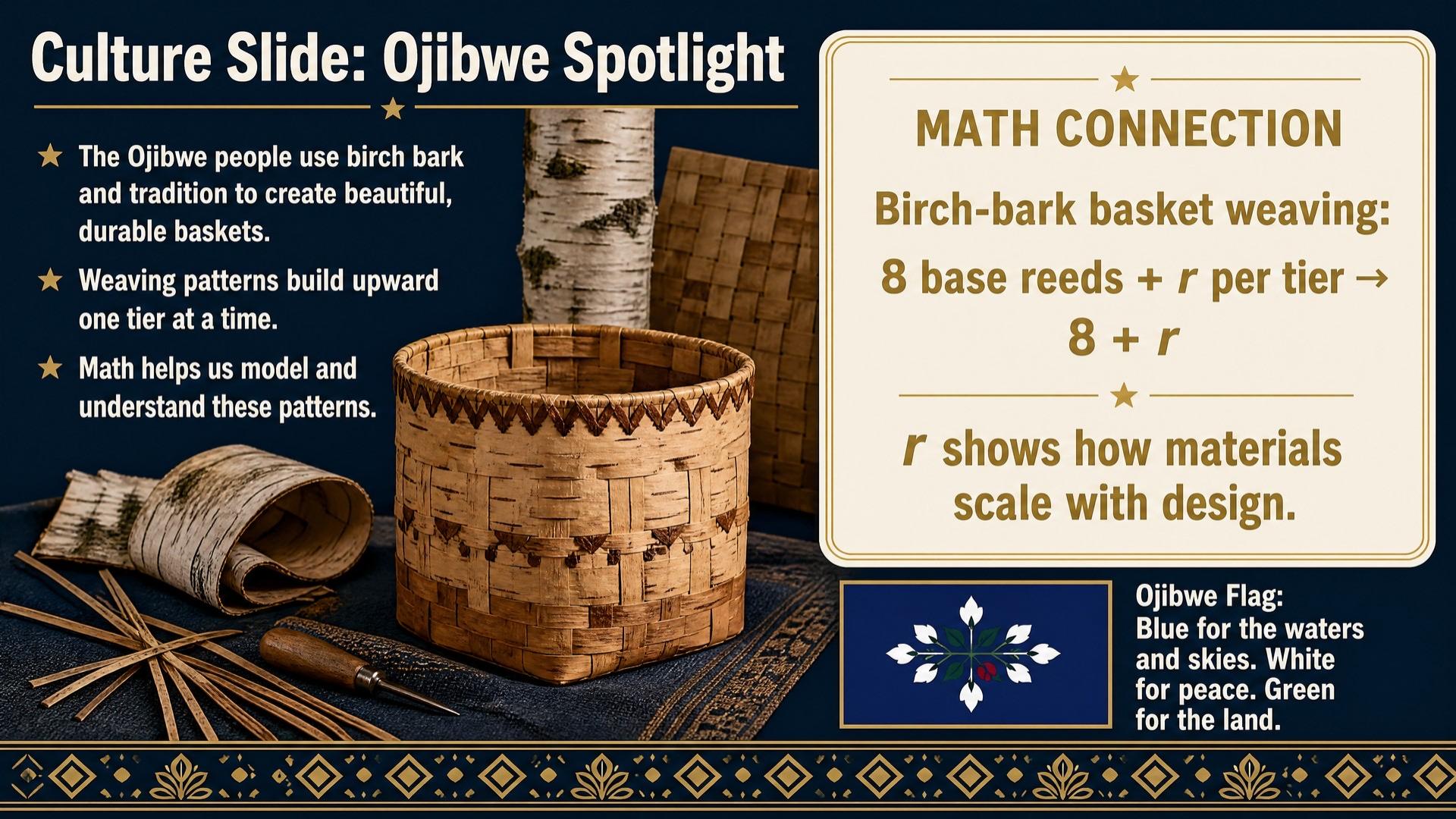
Culture Spotlight: Ojibwe wild rice

Where Careers Meet Algebra

Merit Time Game: Translation Match
Intermediate Algebra, Unit 1: Complete
The entire Unit 1 sample kit is built, polished, and shipped (2026-08-21): 12 categories,244 files. Every future unit and every course replicates this exact structure.
| Folder | Files |
|---|---|
| 01_Lesson_Plans | 18 |
| 02_Guided_Notes | 17 |
| 03_Bell_Ringers | 17 |
| 04_Slide_Decks | 18 |
| 05_Worksheets | 68 |
| 08_Answer_Keys | 17 |
| 09_Teacher_Edition | 17 |
| 10_Pacing_Guide | 1 |
| 11_Standards | 1 |
| 12_Substitute_Plans | 18 |
| Assessments | 50 |
| Scope & Sequence | 2 |
All Unit 1 Lesson 1 Resources
The complete resource set for Lesson 1: What Is a Variable? includes lesson plan, teacher edition, guided notes, tiered worksheets (English and Spanish), bell ringers, game master, PBIS framework and poster, family letters in four languages, and the slide-synced substitute plan.No accounts, no sign-ups. Just real curriculum you can review right now.
Lesson Plans & Teacher Editions
Guided Notes
Each lesson has a printable version and an interactive fillable version with type-in fields.
Worksheets, Bell Ringers & Game Masters
Tiered Ready/Set/Go problem sets, spiral-review bell ringers, and the Merit Time game master, all printable and fillable.
Family Letters, PBIS & Sub Plans
Family letters ship in four languages (English, Hmong, Somali, Spanish); the PBIS framework and poster anchor Merit Time; substitute plans are slide-synced scripts for every lesson.
Unit 1 Assessment Cadence
Quiz 1: Day 7 (covers L1–L5)
Variables, verbal phrases, GEMDAS, one-variable evaluation: 15 min
Download PDFQuiz 2: Day 17 (covers L6–L15)
Formulas, terms, properties, equivalent expressions: 15 min
Download PDFEvery assessment ships with a student version for easy printing.
Complete High School Math Sequence
The sample you just explored is from Intermediate Algebra, but every resource type shown here exists for Algebra 2 and Geometry as well, built to the same standards and structure.
Intermediate Algebra
Variables through career-connected review: 17 lessons, 5 MN standards, full resource set.
Download Sample LessonAlgebra 2
Quadratic, polynomial, exponential, and logarithmic functions: advanced algebraic reasoning.
Schedule a MeetingGeometry
Congruence, similarity, circles, and geometric modeling: same embedded supports and career connections.
Schedule a Meeting
Ready to Bring MEG to Your Classroom?
Everything you saw here, lesson plans, guided notes (fillable and print), tiered worksheets, PBIS game masters, family letters, are available for every lesson in every unit across Intermediate Algebra, Algebra 2, and Geometry.
Schedule a MeetingNo commitment required. We'll walk you through everything included.
Prefer email? Write to Dr. Diaz for more information.