PBIS: Built Into the Lesson,
Not Bolted On
Every MEG course, Intermediate Algebra, Algebra 2, and Geometry, integrates Positive Behavioral Interventions and Supports directly into the curriculum design, from lesson structure and reward moments to classroom management routines and teacher scripts. Your school-wide PBIS framework doesn't stop at the classroom door.
What Is PBIS in MEG's Mathematics Courses?
PBIS is not an add-on in Intermediate Algebra, Algebra 2, or Geometry. It isn't a separate curriculum, a poster you hang and ignore, or a set of extrinsic rewards disconnected from learning.
PBIS is built into the lesson DNA. Every component, the warm-up, the direct instruction, the guided practice, the Merit Time game, the exit ticket, is designed with behavioral expectations and natural reward moments embedded from the start.
This means teachers don't need to invent their own PBIS system or stop instruction to "do PBIS." The curriculum carries the framework. Teachers deliver math and reinforce positive behavior simultaneously, every single lesson.

PBIS by the Numbers
Lessons With Embedded PBIS
Every 50-minute lesson includes structured PBIS moments, not scattered "good job" stickers, but intentional behavioral touchpoints.
Universal Expectations
Be Ready, Be Respectful, Be Responsible, applied consistently across every lesson, every activity, every day.
Tiers of Support
Tier 1 (universal) embedded in curriculum. Tier 2 & 3 intervention scripts in the Teacher Guide for targeted and intensive support.
One Classroom Poster
A single, clear PBIS poster frames expectations for every lesson, with no competing systems and no visual clutter.
Ready. Respectful. Responsible.
Every MEG lesson, in Intermediate Algebra, Algebra 2, and Geometry, reinforces three universal expectations. These aren't abstract rules: they're concrete, observable behaviors tied to specific moments in the lesson structure.
Be Ready
Students arrive mentally and materially prepared to engage with the math. Readiness is built into the lesson structure, not assumed.
Classroom Examples
- Warm-Up Routine: Students enter to a displayed warm-up problem. Expectations set before the bell: materials out, bags away, focus on the board.
- Transition Signals: "Pencils up in 5... 4... 3...", clear verbal and visual cues for shifting activities.
- Material Check: Guided notes and slide prompts remind students to have their supplies ready before independent work.
Be Respectful
Students treat peers, teachers, and the learning environment with dignity. Respect is modeled in every interaction and reinforced through structured participation.
Classroom Examples
- Think-Pair-Share Protocol: Structured partner talk with sentence starters, "I noticed..." "I wonder...", ensuring every voice is heard.
- Discussion Norms: Slide-deck-embedded norms for whole-group discussion: one voice at a time, build on ideas, disagree respectfully.
- Merit Time Game Conduct: Clear expectations for turn-taking, celebrating peers' correct answers, and good sportsmanship.
Be Responsible
Students own their learning, their materials, and their choices. Responsibility is taught explicitly and acknowledged consistently.
Classroom Examples
- Guided Notes: Students complete fill-in-the-blank notes during instruction, building accountability for capturing and organizing their learning.
- Self-Check Moments: Lessons embed "Pause and Reflect" slides where students self-assess their understanding, building metacognitive responsibility.
- Exit Ticket Routine: Students complete a quick-check problem before leaving, taking ownership of demonstrating what they learned.
Aligned to Your School's Expectations
The three expectations, Be Ready, Be Respectful, Be Responsible, are designed to be compatible with virtually any school-wide PBIS system. If your school uses different language (Safe, Respectful, Responsible; or PAWS; or SOAR), the framework adapts. The Teacher Guide includes a matrix alignment tool that maps MEG's expectations to your school's existing language.
Rewards That Reinforce Learning
Effective PBIS rewards are built into the experience, not candy or prizes handed out independently of instruction. Every MEG mathematics course, Intermediate Algebra, Algebra 2, and Geometry, embeds natural reward moments that celebrate positive behavior while keeping students engaged in math.
Merit Time Games
Every lesson ends with Merit Time, a review game that makes math practice social, fun, and rewarding. Games are cooperative and competitive by design, giving students a natural payoff for engagement.
- Team-Based: Students work in small groups, building collaboration and collective problem-solving.
- Low-Stakes Practice: Wrong answers are learning moments, not penalties. Positive participation is the primary reward.
- Celebration Built In: Game master slides include celebration prompts: class applause, team shout-outs, recognition points.
PBIS Bonuses in Game Masters
Game masters (the teacher-facing slide decks for Merit Time) include explicit PBIS bonus prompts that let teachers award recognition for positive behaviors during the game.
- Bonus Point Prompts: "Bonus point for the team that showed the most respectful listening!" Pre-written, ready to use.
- Sportsmanship Recognition: Slides cue teachers to highlight students who help teammates, share strategies, or encourage others.
- Consistent Structure: Same bonus format every lesson: students know what's recognized and why.
Recognition Systems
Beyond individual lessons, every MEG course provides structures for ongoing recognition that connects classroom behavior to school-wide PBIS systems.
- Ticket/Token Systems: Templates and guidance for a simple classroom economy tied to the three expectations.
- Class Charts: Visual progress trackers for recognizing collective class achievement across lessons.
- School-Wide Integration: Guidance for connecting classroom recognition to your school's existing PBIS reward system.
12 Games. One Per Unit. Zero Devices.
A brand-new, zero-device PBIS-integrated classroom game debuts at the start of every unit:12 signature games across the course. No scoreboards, no timers, no devices, friendly competition with natural rewards.
Translation Match
Expressions
Expression Speed Sort
Expressions & equations
Equation Relay Race
Equations
Function Machine
Functions
Line-Up
Linear relationships
System Smackdown
Systems of equations
Exponent Escape Room
Exponents
Polynomial Pictionary
Polynomials
Factoring Frenzy
Factoring
Quadratic Quiz Bowl
Quadratics
Data Detective
Data & statistics
Probability Carnival
Probability
Game-Master Deliverables
Every signature game ships as a complete game master, the teacher-facing materials with rules, round structure, PBIS bonus prompts, and celebration cues. Each game master is built to the same format, so students know what's recognized and why, every single unit.Download the Unit 1 game master (Translation Match) →
Manage the Classroom, Teach the Math
Classroom management isn't separate from instruction: it's the container that makes instruction possible. MEG's Intermediate Algebra, Algebra 2, and Geometry provide structured routines and procedures so teachers spend less time managing behavior and more time teaching mathematics.
Daily Routines
Consistent Lesson Structure
Every lesson follows the same four-phase flow: Bell Ringer → Launch/Hook → Explore & Develop → Reflect & Practice (Merit Time + exit ticket). Students know what comes next, reducing anxiety and off-task behavior.
Embedded Time Cues
Slide decks include suggested timings for each segment. Teachers can use timers, verbal countdowns, or visual progress bars, since the structure is built in.
Predictable Closures
Every lesson ends with an exit ticket, giving students a consistent signal that learning is wrapping up and providing a calm transition to the next class period.
Transition Procedures
Activity Transitions
Clear signals mark shifts between lesson segments: "Pencils down when you hear the chime. Eyes on me in 3... 2... 1..." Pre-written scripts in the lesson plans reduce cognitive load on teachers.
Group Work Formation
Pre-designed grouping strategies for Merit Time and partner work. Teachers don't need to invent grouping systems: the structure is provided, and PBIS expectations for group work are pre-taught.
Material Management
Guided notes and handouts follow a consistent format. Students learn where to find information, where to write responses, and how to organize their materials, reducing confusion and lost work.
Proactive Interventions
Pre-Correction Strategies
Lesson plans identify common behavior risk points and provide proactive prompts: "Before we begin partner work, let's review what respectful collaboration sounds like."
Active Supervision Cues
Teachers are prompted to circulate, provide specific praise, and use non-verbal redirection during independent and group work. The curriculum cues these moves at the right moments.
Re-Direct Scripts
Brief, respectful re-direction language is provided for common off-task behaviors, delivered calmly, focused on the expectation, never on the student's character.
For School Leaders
The MEG classroom management framework is designed to reduce the time teachers spend on behavior management by structuring predictability into every lesson. When teachers have clear routines and scripts, they spend less energy inventing management strategies and more energy building relationships and teaching math. New teachers, in particular, report that the structured routines help them establish positive classroom culture from day one.
The PBIS Poster
Every MEG mathematics classroom comes with a single, unified PBIS poster that frames the three expectations in clear, student-friendly language. The poster is designed to be visible from every seat, a constant visual anchor that connects every lesson to the school-wide behavioral framework.
One Poster, Not a Wall of Rules. Clean design with the three expectations and 2–3 concrete examples per expectation. No competing posters, no visual overload.
Student-Friendly Language. Written in the voice of a Minnesota middle-schooler, direct, clear, and respectful.
Customizable. Available in letter-size and poster-size PDFs. Can be adapted to match your school's PBIS language with the matrix alignment tool in the Teacher Guide.
Referred to in Every Lesson. Teachers are prompted to reference the poster during warm-up, transitions, and Merit Time, keeping expectations visible and active.
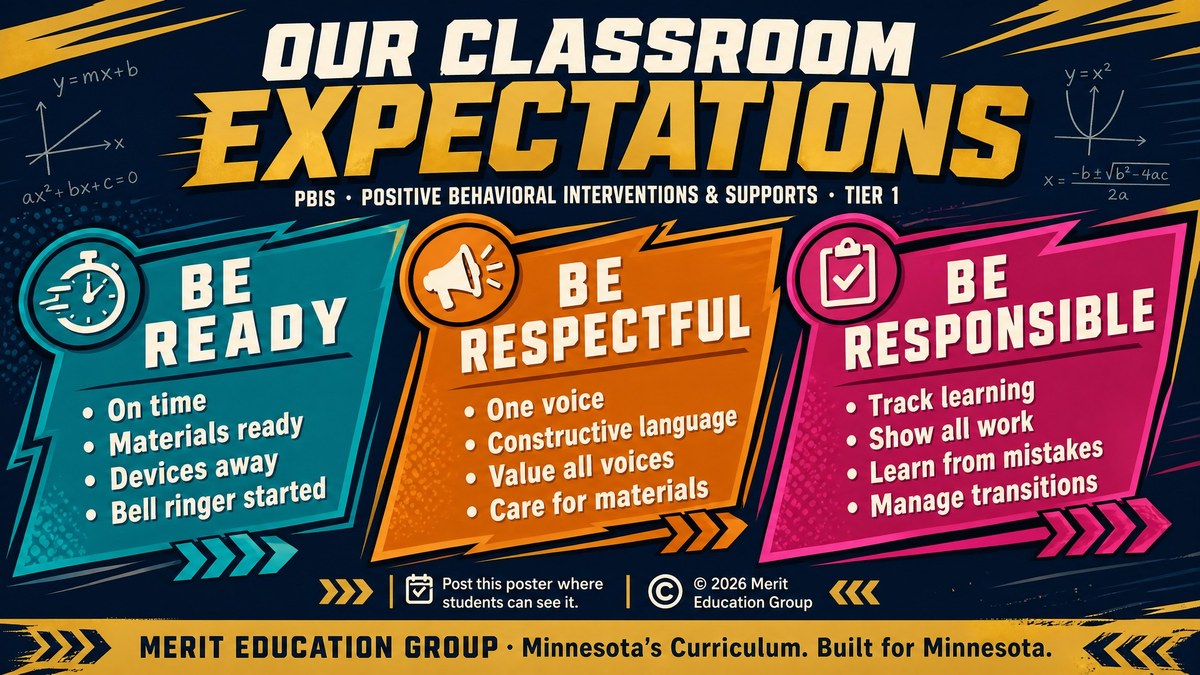
The PBIS Classroom Poster: one-page, student-friendly, always visible.
The PBIS Teacher Guide
The MEG PBIS Teacher Guide is a practical companion that gives teachers the language, scripts, and strategies to implement PBIS effectively from day one, with no additional training required.
Intervention Scripts
Ready-to-use language for addressing common classroom behaviors, from off-task talking to refusal to work. Every script follows the same respectful, expectation-focused structure: State the expectation, name the behavior, invite the correction.
Tier 2 & 3 Support Guidance
Identification strategies, data-tracking templates, and targeted intervention plans for students who need more than universal classroom support. Connects directly to your school's MTSS/PBIS team process.
Implementation Checklist
A step-by-step guide for the first week, first month, and first quarter, so teachers and administrators know exactly what PBIS implementation looks like in an MEG mathematics classroom.
Proactive Teaching Plans
Plans for explicitly teaching expectations at the start of the year and re-teaching them after breaks or when new routines are introduced, because PBIS expectations are taught, not assumed.
What's Inside the Teacher Guide
PBIS Poster & Matrix
Printable poster + school alignment matrix
Intervention Scripts
30+ classroom-tested re-direction scripts
Tier 2/3 Intervention Plans
Data tracking + targeted support strategies
Implementation Checklist
Week 1, month 1, quarter 1 milestones
Expectation Teaching Plans
First-week lessons + re-teaching protocols
Reward System Templates
Ticket systems, class charts, school-wide integration
Merit Time Game PBIS Bonuses
Velocity Bonus, Readiness Reward, Streak Multiplier, Digital Cleanup Bonus

Bring PBIS-Integrated Mathematics to Your School
MEG's Intermediate Algebra, Algebra 2, and Geometry are ready for Minnesota classrooms, complete with embedded PBIS, culturally responsive content, dual-platform delivery, and the teacher support your staff deserves.